
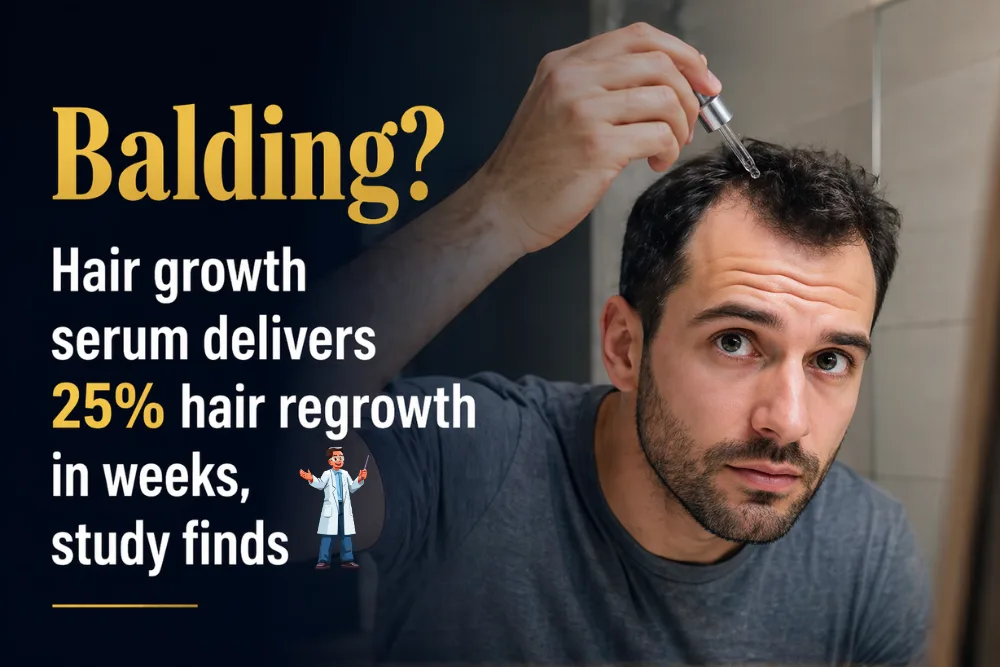
Hair growth serum based on plant extracts has shown early clinical evidence of improving hair thickness and density within just 56 days. In a small controlled study, participants experienced up to 25 percent improvement, suggesting that targeted biological signals may help activate hair follicles faster than traditional approaches.
Why Hair Growth Matters More Than Ever
Hair growth in today’s world is not just a beauty goal, it is closely tied to confidence, identity, and overall well being. Hair loss, especially pattern thinning, affects millions of people across different age groups. For many, it is not just about appearance, but also about emotional health and self perception.
Modern lifestyles, stress, environmental factors, and genetics all play a role in hair thinning. As a result, the demand for effective and reliable hair growth serum solutions has increased significantly. While several treatments exist, most require long term commitment and patience, which often leads to frustration when results are slow or inconsistent.
This growing need has pushed researchers to explore innovative approaches that go beyond traditional chemical treatments. The emergence of plant based formulations represents a shift toward combining natural compounds with advanced biological science.
The Breakthrough Behind This Plant Based Hair Growth Serum
Scientists have recently developed a new hair growth serum using a blend of plant based extracts and biological growth signals. This formulation is designed to stimulate hair follicles and push them into the active growth phase more efficiently.
The research was conducted by a team led by Dr Tsong Min Chang from Schweitzer Biotech Company in Taiwan. Their goal was to determine whether a carefully designed serum could accelerate hair regrowth in a shorter time frame compared to existing solutions.
Unlike many commercial products that rely on marketing claims, this serum was tested in a controlled and blinded clinical setup. This approach ensured that the results were based on measurable data rather than subjective observations.
The study was published on medRxiv, highlighting its early stage nature, but also its scientific relevance. While not yet peer reviewed at the highest level, it provides valuable insights into how plant based compounds can influence hair growth.
What Makes This Hair Growth Serum Unique
The formulation of this hair growth serum is what sets it apart from conventional treatments. It combines both familiar ingredients and advanced biological components that work together to support follicle activity.
The serum includes caffeine and panthenol, which are commonly used in hair care. Caffeine is believed to improve blood circulation in the scalp, which may help deliver nutrients to hair follicles. Panthenol, on the other hand, acts as a conditioning agent, improving hair texture and strength.
The most innovative component is the use of extracellular vesicles derived from a tropical plant called Centella asiatica. These vesicles are tiny structures released by cells, and they act as signal carriers that influence cellular behavior.
In addition to plant vesicles, the serum contains fibroblast growth factor 7 and insulin like growth factor 1. These protein signals are known to play a role in hair follicle development and activity. They are particularly important during the active growth phase of the hair cycle.
The combination of these elements is not random. Each component targets a specific aspect of hair growth, creating a multi layered approach that aims to deliver faster and more noticeable results.
How the Clinical Trial Was Conducted
The effectiveness of this hair growth serum was tested through a structured clinical trial involving 60 adults between the ages of 18 and 60. Participants were divided into five groups, including one placebo group to ensure accurate comparison.
Each participant applied one millilitre of the serum to their scalp every night for eight weeks. This consistent routine allowed researchers to monitor changes over time and evaluate the serum’s impact on hair growth.
Measurements were taken at multiple intervals, specifically on days 14, 28, 42, and 56. Researchers tracked key indicators such as hair density, thickness, length, and shedding.
The study design included both placebo controls and blinding, which are essential for reducing bias. Four active groups were created, each with a progressively advanced formulation. The first group used a basic formula, while the final group used the complete combination of all ingredients.
This step by step approach allowed researchers to identify the contribution of each component and determine which combination delivered the best results.
Results After 56 Days of Use
By the end of the eight week period, the results showed clear improvements in hair growth among participants using the full combination serum. Hair density increased by nearly 25 percent compared to the placebo group.
In addition to density, hair strands became noticeably thicker. This suggests that the serum not only encouraged new growth, but also strengthened existing hair.
The findings indicate that plant based vesicles and growth factors may enhance the environment around hair follicles, making it more conducive for growth. Each added ingredient appeared to contribute to the overall effectiveness, with the complete formula delivering the strongest results.
One of the most notable aspects of the study is the speed of improvement. Hair growth is typically a slow process, yet measurable changes were observed within just a few weeks. This makes the serum particularly interesting for further research and development.
Understanding the Science of Hair Growth Signals
Hair grows in cycles that include growth, resting, and shedding phases. Most treatments aim to extend the active growth phase, as this is when hair length and thickness increase.
The inclusion of insulin like growth factor 1 and fibroblast growth factor 7 in the serum is significant because these signals are known to influence the growth phase. They help regulate cell activity within the follicle, encouraging it to remain active for longer periods.
Centella asiatica, the plant source used in the serum, has been widely studied for its effects on skin health. It is believed to have anti inflammatory properties and may improve the overall condition of the scalp.
Caffeine contributes by potentially enhancing blood flow, which supports nutrient delivery to follicles. Panthenol improves hair quality by retaining moisture and adding strength to individual strands.
Together, these components create a supportive environment for hair growth, addressing both biological signals and scalp health.
Limitations of the Study and What to Consider
Despite the promising results, the study has several limitations that need to be addressed before drawing firm conclusions. The trial was relatively short, lasting only eight weeks, which is not sufficient to fully understand long term hair growth patterns.
Another limitation is the participant group. The study involved healthy adults rather than individuals with diagnosed pattern hair loss. This means the results may not directly apply to those experiencing more severe or genetic hair loss conditions.
There is also the question of potential bias, as company employees were involved in the research. While this does not invalidate the findings, it highlights the need for independent studies to confirm the results.
Additionally, the serum was not compared directly with established treatments. Without such comparisons, it is difficult to determine how effective it is relative to widely used options.
What Needs to Happen Before This Becomes Mainstream
For this hair growth serum to gain widespread acceptance, further research is essential. Larger clinical trials involving diverse populations are needed to validate the findings.
Future studies should include participants with diagnosed hair loss conditions and track outcomes such as hair count per area. This would provide a clearer picture of the serum’s effectiveness in real world scenarios.
Direct comparisons with existing treatments are also necessary. This will help determine whether the new formulation offers any significant advantages.
Safety is another important factor. Even if the ingredients are considered low risk, researchers must monitor for potential side effects such as scalp irritation or unexpected hair shedding.
Consistency in production is equally important. If plant based vesicles are a key factor in the results, manufacturers must ensure that each batch maintains the same quality and concentration.
How This Compares to Existing Hair Growth Treatments
Currently, treatments like minoxidil and finasteride remain the most reliable options for hair loss. These treatments are supported by extensive clinical research and are widely recommended by medical professionals.
Minoxidil works by improving blood flow to the scalp and prolonging the growth phase of hair follicles. Finasteride, on the other hand, targets hormonal factors that contribute to hair loss.
While these treatments are effective, they often require long term use and may come with side effects. This is why the idea of a plant based hair growth serum is appealing to many people.
However, it is important to note that the new serum is still in its early stages of research. While the initial results are encouraging, they do not yet match the level of evidence supporting established treatments.
What This Means for You Right Now
For individuals experiencing hair loss, this new hair growth serum represents an interesting development, but not a guaranteed solution. The results suggest potential, but more evidence is needed before it can be considered a reliable option.
Consistency remains the most important factor in hair growth. Whether using traditional treatments or new formulations, long term commitment is essential for achieving and maintaining results.
It is also important to approach new products with realistic expectations. Quick improvements can be appealing, but sustainable growth typically requires time and ongoing care.
Consulting a healthcare professional before starting any treatment is always recommended, especially for those with underlying conditions or severe hair loss.
Conclusion
The development of this plant based hair growth serum marks an exciting step forward in the search for effective hair loss solutions. With early evidence showing up to 25 percent improvement in hair density within 56 days, it highlights the potential of combining natural extracts with advanced biological signals.
However, the journey from promising research to widely accepted treatment requires further validation. Larger trials, independent studies, and long term data will be essential in determining its true effectiveness.
For now, this serum stands as a glimpse into the future of hair care, where science and nature work together to address one of the most common concerns in modern life.
Frequently Asked Questions
What is a hair growth serum
A hair growth serum is a topical product designed to stimulate hair follicles, improve scalp health, and promote thicker and stronger hair over time.
How effective is this new plant based serum
Early studies show up to 25 percent improvement in hair density within 56 days, but more research is needed to confirm long term effectiveness.
Is this serum better than existing treatments
There is no direct comparison yet, so established treatments remain more reliable for now.
Are there any side effects
The study did not highlight major side effects, but further research is needed to fully evaluate safety.
Can it work for severe hair loss
The study involved healthy adults, so its effectiveness for severe or genetic hair loss is still unknown.
How long does it take to see results
Initial improvements were observed within a few weeks, with significant changes by 56 days in the study.

Founder of Fashion Design Ideas.